
GERMANY'S PENSION PROBLEM
Germany has a pension problem.
But what matters is what it means for your own retirement.
Germany's statutory pension system is under growing demographic pressure: fewer people of working age have to support a growing number of retirees.
For you, the important question is not only what happens to the pension system. It is how much retirement income you may personally need to build beyond your statutory pension.
Key figures of the statutory pension
21,49 Mio.
Pensioners excluding orphan pensions (1 July 2025)
18,6 %
Contribution rate (2026)
What does this mean for you?
The bigger question is not only how Germany will finance its pension system in the future.
It is how much retirement income you may personally have available, and whether that could leave a gap compared with the income you want.
DESIRED RETIREMENT INCOME
€3,000 / month
EXPECTED STATUTORY PENSION
€2,050 / month
POSSIBLE PENSION GAP
€950 / month
Illustrative example, not a personal calculation.
01 — System
How does the statutory pension work?
The statutory pension insurance works essentially on a pay-as-you-go basis. A large part of the current income is used to finance current pension payments. In addition, extensive tax revenues flow into the system as federal subsidies.
This system depends, among other things, on how the number of contributors, employment, wages, and the number of pensioners develop.
How the pay-as-you-go system works · 2026
Money enters the pension system
Employees and employers pay contributions. The federal government adds money from taxes.
The pension insurance system pools the money
The statutory pension insurance system manages the current income.
It pays today’s pensions
The money received today mainly finances the pensions being paid today.
Important: your contributions are not fully saved for your own future pension.
LONG-TERM VIEW 1957–2022 · 2026 MODEL VALUE
How many contributors mathematically correspond to one pensioner?
The historical time series shows the development through 2022. The current BMAS model value for 2026 is highlighted separately; it uses standardized equivalents and is not a measured headcount of actual employees.
Equivalent contributors per equivalent pensioner
Definition, calculation and rounding
Equivalent contributors: contributions from employees subject to compulsory insurance, marginal employees and unemployment-benefit recipients, divided by the contribution due on average earnings. Equivalent pensioners: total pension volume divided by a standard old-age pension based on 45 earnings points.
Chart calculation: equivalent contributors ÷ equivalent pensioners; this is the inverse of the official pensioner ratio under section 68(4) SGB VI.
Calculated from the published values in thousands and rounded to two decimal places using standard rounding.
Sources and data status
Actual 2004–2024: German Pension Insurance, “Rentenversicherung in Zeitreihen 2025”, p. 268 (pension-adjustment base values; published October 2025). Open primary source
2025–2039: Federal Ministry of Labour and Social Affairs, “Rentenversicherungsbericht 2025”, table B 3.5, p. 61 (medium wage and employment scenario; report dated November 2025). Open primary source
Values from 2025 are model-based advance calculations, not forecasts. The chart marks the transition with a dashed separator.
02 — Data
Why is the system under pressure?
Pensioners
Contribution rate (2026)
Pension expenditure (2024)
LONG-TERM VIEW 1957–2022 · 2026 MODEL VALUE
How many contributors mathematically correspond to one pensioner?
The historical time series shows the development through 2022. The current BMAS model value for 2026 is highlighted separately; it uses standardized equivalents and is not a measured headcount of actual employees.
Historical actual value 2022: 2.17
Equivalent contributors: contributions from employees subject to compulsory insurance, marginal employees and unemployment-benefit recipients, divided by the contribution due on average earnings. Equivalent pensioners: total pension volume divided by a standard old-age pension based on 45 earnings points.
Source: DestatisGermany's pension problem is important.
But what matters is yours.
The crucial question is not just how the pension system develops. But how your expected provision fits the life you want to lead in retirement.
DESIRED RETIREMENT INCOME − EXPECTED PROVISION
YOUR PENSION STATEMENT
What do the values in your pension statement mean?
The pension statement contains several amounts and technical terms. Click a point to see what it means – and which value matters for the calculator.
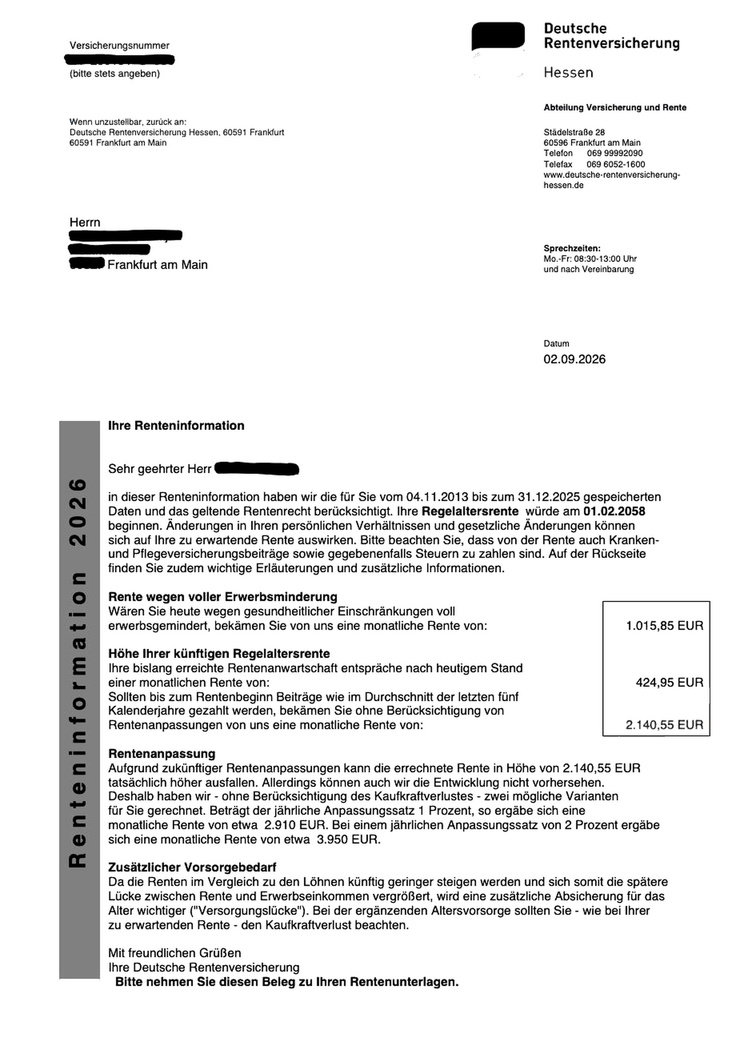
Anonymized sample pension statement from the supplied PDF. Click the numbered markers in the document.
Selected
Future standard old-age pension
The future standard old-age pension is the key planning value for the calculator. It is projected on the assumption that your contributions continue at roughly the average level of the last five calendar years.
For your calculation: Enter this amount from your pension statement as your expected statutory gross pension.
All terms at a glance
These explanations are based on the supplied guide to the German Pension Insurance pension statement. The statement is a projection, not a guarantee.
03 — Calculator
Pension Gap Calculator
Keep your pension statement nearby. We show you which amount to enter.
This calculator is for orientation only and intentionally kept simple. Simplified model: retirement at age 67, the personal purchasing-power value from your pension statement and TK contribution rates for 2026 assuming no children (8.645% health insurance and 4.2% long-term care insurance). Income tax and other retirement income are not included. No individual advice.
TK contribution rates for pensioners 2026Where can I find the correct amount?
Use this amount:
“Künftige Regelaltersrente” – the projected monthly pension assuming continued contributions at the average level of the last five calendar years.
Do not use this amount:
“Bislang erreichte Rentenanwartschaft” – this amount assumes no further contributions before retirement.
The amount in your pension statement is gross. Health and long-term care insurance are deducted in the result.
Under “Kaufkraftverlust”, your pension statement also shows what €100 at retirement would be worth in today’s money. Copy that value into the next field. The examples with 1% and 2% pension adjustments are not guarantees.
From pension problem to personal strategy.
rentenproblem.de helps you understand the problem and assess your personal situation. NEOdirect can support you in analyzing existing provision and comparing different options with each other.
UNDERSTAND SITUATION
ASSESS PROVISION
IDENTIFY POSSIBLE GAP
COMPARE OPTIONS
DEVELOP STRATEGY
You now know your possible gap. What can you do with it?
A pension gap does not automatically mean you need a specific product. What matters is what provision is already in place and what combination fits your life, income, and goals.
The next step is therefore not automatically a product – but first a sensible assessment of your personal situation.
04 — Options
What are the options?
STATUTORY PENSION
What claims already exist and how are they developing?
CORPORATE PENSION
What options does your employer offer and what provision results from them?
PRIVATE PENSION
Which long-term provision solutions fit your personal situation?
WEALTH BUILDING / INVESTMENTS
How much flexibility and long-term wealth building do you want in addition?
The right strategy often emerges from a combination – not from a single product.
Calculate my pension gapFAQ
Frequent questions about the pension problem
The most important questions about the statutory pension, pension gap, and personal retirement provision.
The data behind the pension problem
Want to dive deeper? Here you find the verified demographic and financial key figures behind the relationships shown.
| Indicator | Value | Source / Note |
|---|---|---|
| Equivalent contributors per equivalent pensioner | 1.87 | BMAS Pension Insurance Report 2025, table B 3.5 (2026 model calculation) |
| Pensioners excluding orphans’ pensions | 21.491m | DRV key statistics (1 July 2025) |
| Pensions paid | 26.208m | DRV key statistics (31 December 2025) |
| Statutory pension insurance contribution rate | 18.6% | DRV contribution-rate reference (2026) |
| Total pension insurance expenditure | €402.77bn | DRV Pension Insurance in Figures 2025 (2024 data) |
| Pension expenditure included | €360.14bn | DRV Pension Insurance in Figures 2025 (2024 data) |
| General federal subsidy | €56.94bn | DRV Pension Insurance in Figures 2025 (2024 data) |
| Additional federal subsidies to the general pension scheme | €30.84bn | DRV Pension Insurance in Figures 2025 (2024 data) |
Data & Methodology
The data is based on published statistics from official bodies. The illustrative analysis is not individual advice or an investment or insurance offer.
Do you know your pension gap?
Understand what provision you can expect – and how it fits your personal goals in retirement.
"We cannot solve Germany's pension problem alone. But we can understand your personal situation."